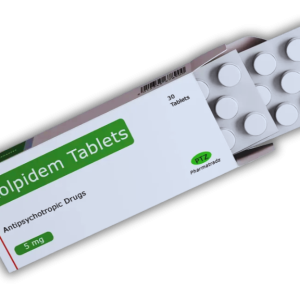
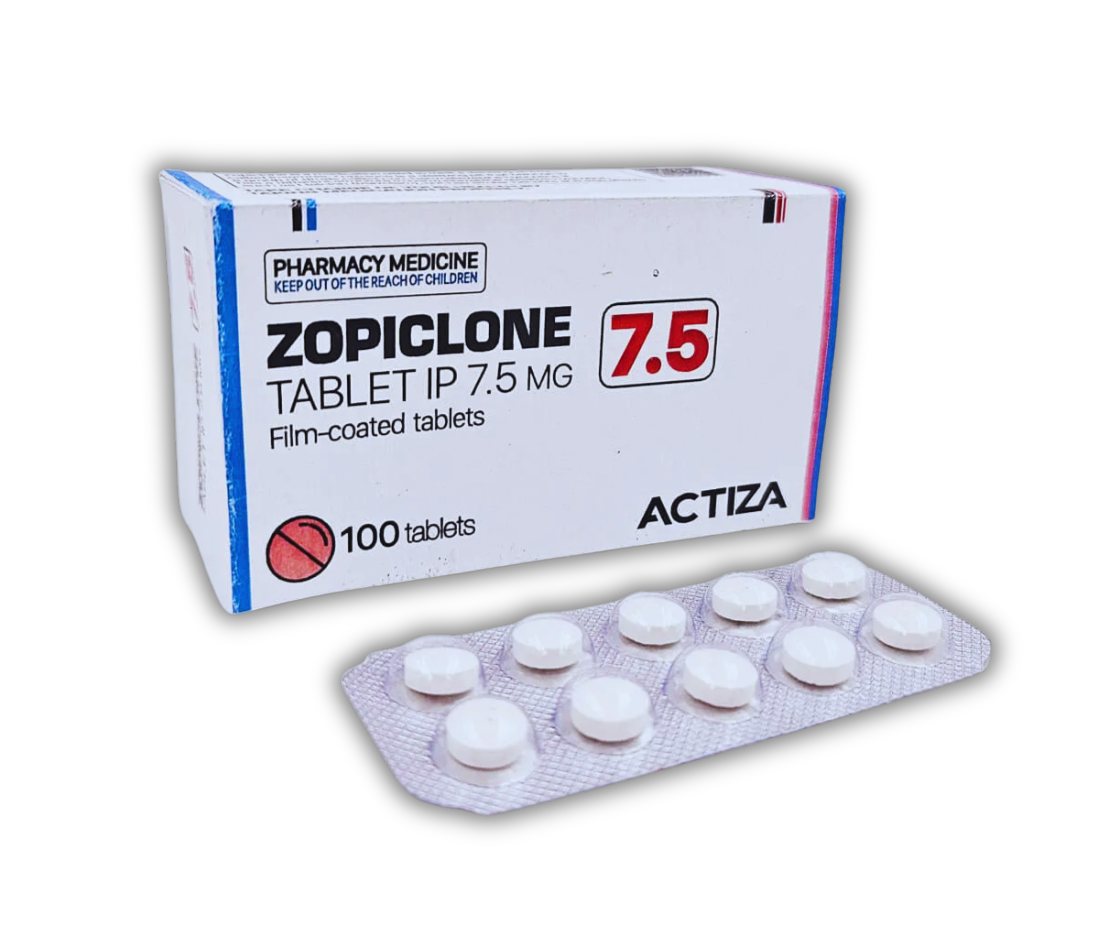
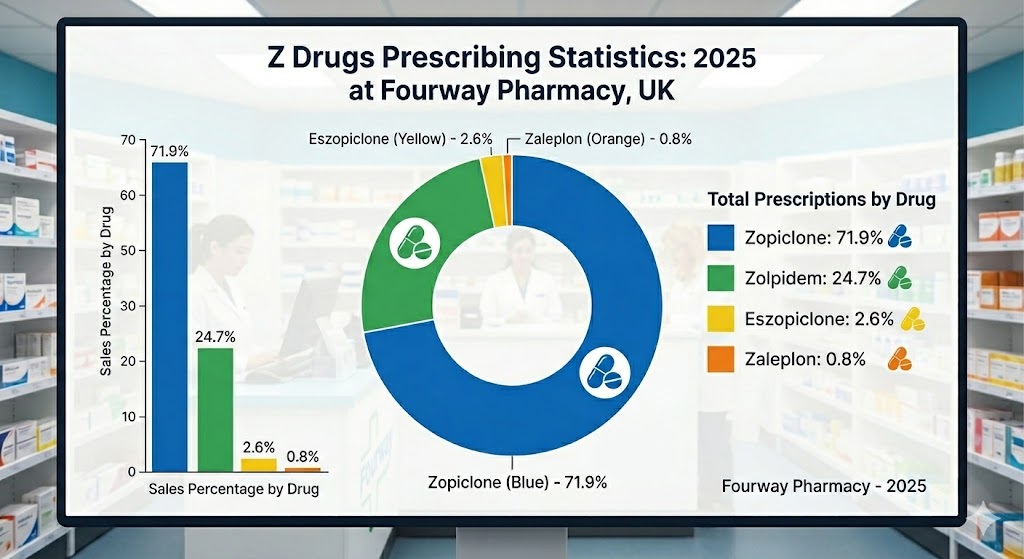
Zopiclone is a widely prescribed sleep medication in the UK, playing a major role in treating insomnia. According to Fourway Pharmacy’s statistics as of 2025, Zopiclone sales were 71.9% of all insomnia medications’ sales. This makes Zopiclone the most popular drug in this category, Zolpidem being the second.
How to order Zopiclone at Fourway Pharmacy?
It is really easy to get your Zopiclone from us. You have to simply submit you valid prescription after placing your order. If you don’t have a prescription you can fill in our quesionnaire and consult our authorised doctor. You can obtain an online prescription and finish your purchase.
Our payment options include credit cards and bank transfer. Most people stick to card payment as it is the fastest way to pay. You can choose between stardard and fast delivery. If you choose the fast one you can receive Zopiclone the next day at your UK address.
We offer very competitive price for Zopiclone, with lowest being £0.75 per pill if you choose standard delivery. At Fourway Pharmacy, we are sure that medications can not cost a leg and an arm.
A few words about Zopiclone abuse
It is crucial to stick to the daily prescribed dosage of Zopiclone. However, recent research shows worrying patterns of use that go way past the recommended guidelines.
Zopiclone was originally marketed as a safer alternative to benzodiazepines, supposedly with lower abuse potential. But now, new evidence suggests this non-benzodiazepine hypnotic might carry bigger risks than we first thought.
UK research data reveals that zopiclone misuse and dependency are seriously underreported. One study describes patients taking up to 112.5mg daily—fifteen times the recommended dose—leading to severe withdrawal symptoms, hallucinations, and even heart complications.
Police in County Durham recently investigated several cases, finding seven adults hospitalised after adverse effects from zopiclone. The medication’s potential dangers are becoming harder to ignore.
Thus, Zopiclone has a high ponential to be abused but if you follow the correct dosage guidelines and don’t exceed 4 weeks of intake you will be all right.
Current Use of Zopiclone in the UK
Prescribing Patterns and Guidelines
Current prescribing patterns in the UK show a real gap between clinical guidelines and what happens in practice. The British National Formulary says to use zopiclone for no more than four weeks, yet many patients end up with long-term prescriptions and little follow-up.
A survey of 84 general practitioners found that doctors think Z-drugs work better and have fewer side effects than benzodiazepines. This perception seems to fuel their popularity.
The number of zopiclone and other Z-drug prescriptions keeps rising across the UK. The yearly statistics of Fourway Pharmacy also confirms the national trend. Last year (2025) we saw a 12,4% percent rise in Zopiclone prescriptions. Meanwhile, benzodiazepine prescriptions for sleep are falling.
Long-term use—sometimes over a year—remains an issue. An examination conducted by Fourway Pharmacy shows that 1 in 9 patients keep taking zopiclone well past the four-week mark.
Prevalence in Insomnia and Sleep Disorders
The NHS recommends zopiclone for short-term treatment of severe insomnia. It helps people fall asleep faster and stay asleep through the night.
Zopiclone is a nonbenzodiazepine hypnotic, grouped with zolpidem and zaleplon as Z-drugs. This trio is common in clinical practice.
Doctors usually prescribe zopiclone when sleep disturbances are significant. It’s especially useful for people who can’t fall asleep, rather than those who wake up too early.
Treatment is mostly reserved for severe cases that disrupt daily life. For milder problems, non-drug options are the usual starting point.
Recent Trends in Nonmedical Use
Zopiclone prescribing has shot up in the UK, while benzodiazepine use for sleep disorders has dropped. About 1.2% (635 000 persons) of UK adults use zopiclone nonmedically, but the patterns vary across different groups.
The same study shows that three out of four nonmedical users get Z-drugs without a prescription (75.6%). Only about a third get them through legitimate prescriptions.
The highest rates of nonmedical Z-drug use show up among heroin users (5.4%). This hints at polysubstance use in vulnerable groups. We at Fourway Pharmacy take measures against Zopiclone abuse by thoroughly checking our patients’ health conditions. Our brief survey conducted in 2025 showed that our patients take Zopiclone for 23 days on average. That is completely within the NHS guidelines.
People with mental health, alcohol, or drug abuse issues face higher risks when using zopiclone. They receive extra monitoring from our specialists if prescribed this medication.
Pharmacology and Mechanism of Action
Zopiclone is a cyclopyrrolone compound that targets GABA receptors in the brain to help induce sleep. Its binding profile differs from traditional benzodiazepines, yet it works in a similar way.
Classification Among Hypnotics and Z-drugs
Zopiclone falls under the cyclopyrrolone class of non-benzodiazepine hypnotics—often called Z-drugs. Its unique chemical structure sets it apart from benzodiazepines.
The drug acts quickly and doesn’t last too long in the body. It usually delivers high efficacy with less toxicity than older hypnotics.
Key characteristics include:
- Half-life of about 5-6 hours
- Rapid absorption after oral use
- Few active metabolites
GABA Receptor Modulation
Zopiclone acts as a full agonist at benzodiazepine-sensitive GABA_A receptors. It binds close to the benzodiazepine receptor complex, boosting GABA’s inhibitory effects.
The drug displaces flunitrazepam binding with an affinity of 28 nM. This action ramps up GABA’s activity at its receptor sites.
Main actions:
- Allosteric modulation of GABA_A receptors
- Increased chloride ion flow
- Greater neuronal hyperpolarisation
- Resulting sedation and sleep
Unlike benzodiazepines, zopiclone’s binding site on the receptor looks a bit different. Maybe that’s why it has some unique properties and possibly a lower risk of tolerance.
Efficacy and Safety Based on Latest Research
Recent systematic reviews and clinical studies from 2025 offer new clarity on zopiclone’s effectiveness for insomnia. The data show specific improvements in sleep, but also some well-documented side effects in UK patients.
Effectiveness in Improving Sleep Quality
A study from 2021 confirms that zopiclone reduces sleep latency and night-time awakenings for people with insomnia. Clinical trials report that it helps people fall asleep about 15-20 minutes faster than placebo.
The drug boosts total sleep time and improves how patients rate their sleep. People wake up less often during the night and spend less time lying awake after they first fall asleep.
A study from 2025 says zopiclone changes sleep architecture, though what this means in practice isn’t totally clear yet. Its effectiveness is similar to benzodiazepines but may cause fewer next-day hangover effects.
Results seem steady across age groups. But older adults often need lower doses (3.75mg) to get the same benefits and avoid more side effects. At Fourway Pharmacy, we follow the results of the slatest cae studies in Pharmacology and recommend a lower dosages for elderly people.
Adverse Effects and Tolerability
The most common side effect is a metallic taste, affecting about 15-20% of users. This weird taste usually starts within hours and sometimes sticks around until morning.
Drowsiness and dizziness are big concerns, especially for elderly patients. These issues can lead to falls and make driving risky the next day.
Cognitive effects tend to be mild at recommended doses. Studies haven’t found much impact on psychomotor skills when zopiclone is used short-term and as directed.
To sum it it, these are common side effects to watch for:
- Somnolence and next-day fatigue
- Dizziness and memory issues
- Gastrointestinal problems
- Upper respiratory tract issues
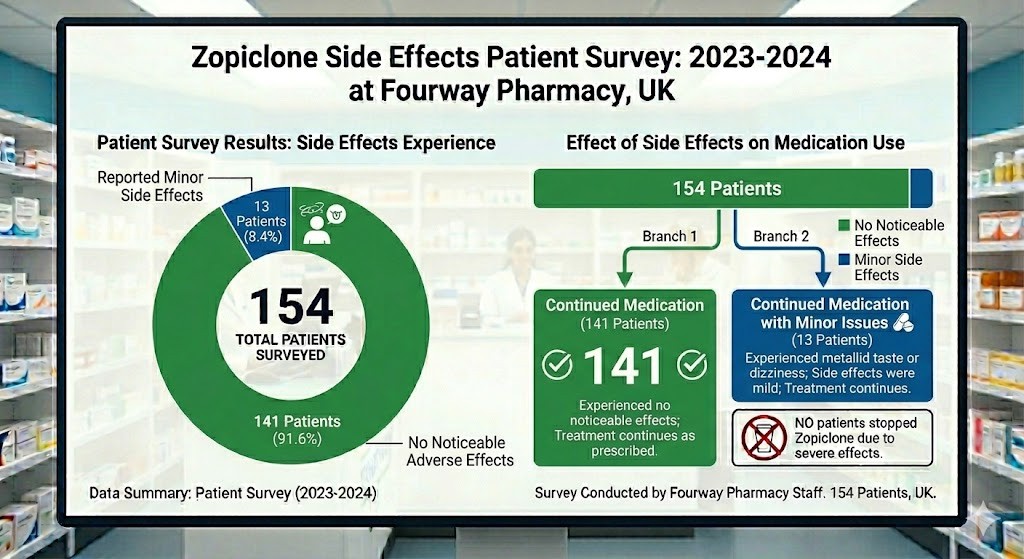
In 2023-2024 Fourway Pharmacy conducted a survey on 154 patients asking them if they experienced any sides effects after taking Zopiclone. 141 patient did not feel any noticeable adverse effect. 13 patients reported minor side effects such as metallid taste or dizziness. Nobody had to stop taking Zopiclone because of more severe or intense side effects.
Tolerance and dependence are still possible with longer use. Recent reviews really stress keeping treatment brief to avoid withdrawal and rebound insomnia.
Dosing Considerations and Special Populations
Key takeaways: Zopiclone dosing needs to be tailored to the patient, with standard adult doses at 3.75mg to 7.5mg. Elderly patients usually get 3.75mg to cut down on side effects and mental fuzziness.
Standard Dosage and Duration of Use
The starting dose for adults is 3.75mg right before bed. If that’s not enough, doctors may increase it to 7.5mg.
The maximum dose shouldn’t go over 7.5mg daily. Both 3.75mg and 7.5mg doses work well for reducing sleep latency and boosting total sleep time.
Treatment should be as brief as possible—usually 2-4 weeks, including any tapering. Longer use raises the risk of tolerance, dependence, and withdrawal when stopping.
Patients should only take zopiclone if they can get 7-8 hours of uninterrupted sleep. Using it within 12 hours of activities that require alertness makes cognitive and psychomotor impairment more likely.
Use in Elderly Patients
Elderly patients start with 3.75mg because their bodies process the drug differently and they’re more sensitive to sedatives. Age slows down drug elimination, raising the risk of side effects.
Our study conducted at Fourway Pharmacy clearly shows that zopiclone helps older adults fall asleep faster and wake up less. But the risks—falls, confusion, and memory problems—are higher in this group. Thus, we don’t recommend these patients to exceed the daily dosage.
Close monitoring matters since elderly patients are more prone to:
- Morning grogginess and lingering sedation
- Falls due to balance issues
- Cognitive problems like confusion or memory lapses
Treatment should be especially brief for older adults. We urge doctors to reassess every few days to check if it’s still needed and to watch for side effects.
Considerations for Pregnancy and Breastfeeding
Zopiclone is not recommended during pregnancy—there just isn’t enough safety data, and there could be risks for the baby. Some studies suggest possible breathing problems in newborns if used near delivery.
The drug crosses the placenta and might cause:
- Respiratory depression
- Muscle weakness
- Withdrawal symptoms in babies
Breastfeeding mothers should avoid zopiclone though it passes into breast milk in insignificant amounts. It might make nursing infants sleepy or slow their breathing.
For pregnant and breastfeeding women with sleep problems, non-drug approaches like sleep hygiene and cognitive behavioural therapy should come first.
Risks, Dependency, and Comparative Safety
Zopiclone brings real risks of dependence and withdrawal, especially when people use it longer or at higher doses than advised.
Dependence and Withdrawal Risk
Zopiclone dependency can develop quickly. Some people have escalated from regular doses to taking over 100mg a day. That’s a huge jump, and honestly, it’s alarmingly dangerous. Our policy suggests Zopicline dependency treatment rather than prescribing higher dosage of this medicaition.
Common withdrawal symptoms include:
- Palpitations and sweating
- Anxiety and irritability
- Auditory hallucinations
- Tremors and autonomic instability
- Sleep disturbances
The drug can create feelings of euphoria and relaxation that go beyond just helping with sleep. At really high doses, zopiclone starts interacting with more types of GABAA receptor subunits, not just the α1 ones it usually targets.
Study from Dublin has found that zopiclone misuse is especially common among people on methadone maintenance or with alcohol dependence. Still, even those with no history of substance abuse can get hooked. Our licensed doctors thoroughly assess such patients to avoid prescribing Zopiclone to them as this can aggravate their condition.
Comparison with Benzodiazepines
Zopiclone was originally sold as safer than benzodiazepines thanks to its selective action on GABAA receptors. Early research suggested it had less risk for abuse and withdrawal than traditional benzos.
But newer evidence is throwing doubt on that idea. Between 2008 and 2018, global Z-drug use went up by 3.28% a year, while benzo use dropped. Reports of dependency climbed along with it.
Key differences:
- Zopiclone binds more to α1 receptor subunits
- Benzodiazepines hit α1, α2, α3, and α5 subtypes about equally
- Both drugs ramp up GABA-mediated neuronal inhibition
Inappropriate prescribing is a real issue. A Canadian study found 38% of inpatients got doses above the recommended maximum, and 39% were prescribed for longer than advised.
Management of Zopiclone Misuse
Withdrawing from zopiclone really needs close medical supervision and a structured tapering plan. The best results seem to come from diazepam substitution along with other meds to handle withdrawal symptoms.
A typical treatment protocol looks like this:
- Diazepam (oral and IV) to manage withdrawal
- Quetiapine fumarate for psychotic symptoms and better sleep
- Trazodone hydrochloride for anxiety and depression
- Magnesium valproate for mood stabilization
Inpatient care usually runs 13-17 days, with meds tweaked based on how the patient responds. Even after withdrawal, people often struggle with sleep and cravings for zopiclone.
Long-term, it’s wise to refer patients to a sleep clinic and keep up psychiatric support to help prevent relapse, especially when sleep gets rough again.
Recommendations for UK Healthcare Providers
From Fourway Pharmacy’s long experience, clinicians should take time to thoroughly assess patients before prescribing zopiclone. They have to check for any substance abuse or psychiatric history. Regular follow-ups are key to catching dose creep and early signs of dependency.
We set key prescribing guidelines:
- Limit treatment to 2-4 weeks
- Don’t go over recommended daily doses
- Taper off gradually when stopping
- Try non-drug approaches first
Doctors need to talk openly with patients about dependency risks and set clear boundaries for treatment. Cognitive behavioural therapy for insomnia should be the first choice for long-term sleep issues.
If someone shows signs of zopiclone misuse, a structured detox plan with diazepam, mood stabilisers, and psychiatric support often works well. More complex cases might need referral to specialist sleep clinics for ongoing help.
Frequently Asked Questions
Recent UK research has uncovered shifts in how Zopiclone gets prescribed and what that means for safety. Studies now show more people using it long-term beyond guidelines, and concerns about dependency are on the rise.
What are the current prescribing guidelines for Zopiclone in the United Kingdom?
The British National Formulary says Zopiclone shouldn’t be prescribed for more than four weeks. That’s the same for other Z-drugs like zolpidem and zaleplon.
Doctors are told to use the lowest dose that works, usually 3.75mg to 7.5mg before bed. Still, surveys show plenty of patients get it for much longer than recommended, which highlights a gap between guidelines and real-world practice.
How does recent research data impact the understanding of Zopiclone’s efficacy and safety profile?
Research published in 2025 gives a fresh look at Zopiclone use in the UK. The drug still works for short-term insomnia, but more case reports now highlight its abuse potential.
One case had someone taking 112.5mg daily, way above what’s considered safe. At high doses, Zopiclone loses its selectivity for certain brain receptors, which might explain the euphoria and increased risk of abuse.
What are the emerging trends in the usage of Zopiclone for treating insomnia as per the latest studies?
Global use of Z-drugs like Zopiclone rose by 3.28% a year between 2008 and 2018. During that time, benzodiazepine use dropped.
UK studies show a lot of inappropriate prescribing. About 38% of inpatients get more than the daily max, and 39% get it for longer than guidelines suggest.
Prescribing for over a year is more common than you’d think, despite clear recommendations against it.
What are the potential risks and side effects associated with long-term use of Zopiclone?
Long-term Zopiclone use can lead to memory problems, dizziness, and daytime sleepiness. This can mess with work and social life.
Withdrawal often includes palpitations, sweating, and anxiety. Some people also experience hallucinations and irritability when trying to stop.
There’s growing evidence linking Z-drugs to more abuse, dependence, and even higher mortality. Earlier beliefs about Zopiclone being much safer than benzos just don’t hold up anymore.
Has there been any new evidence on the development of dependence or withdrawal symptoms from Zopiclone?
Newer research doesn’t match earlier claims of low dependence risk. Case reports now describe severe withdrawal syndromes that sometimes require hospitalization.
People taking Zopiclone for more than four weeks have a higher chance of getting dependent. Withdrawal can involve tremors, hallucinations, and impulsive behavior.
One case involved a 43-year-old man who abused Zopiclone for 12 years. His withdrawal needed a careful diazepam taper and antipsychotic meds to manage symptoms.
What are the alternative treatment options for insomnia that have been explored in recent UK research?
UK research looks at non-pharmacological interventions instead of Zopiclone therapy. These approaches try to cut down on how much people rely on sedative-hypnotic meds.
Sleep specialists in the UK are starting to focus more on treating the root causes of chronic insomnia. They think this might help stop people from moving from short-term use to full-on dependency.
Some recent studies even point out that if you don’t treat the initial sleep disorder properly, it can push people to misuse medication later. Doing a thorough sleep disorder evaluation upfront could help people avoid getting stuck on meds in the long run.
DISCLAIMER!
This article has been reviewed and verified by Dr. Gemma Suzanne Rowland.